
Most people assume their teeth are the main event when it comes to dental health. Gums get treated as supporting cast. But gum disease, also called periodontal disease, affects roughly 3 in 10 Australian adults to some degree, and the majority of them have no idea anything is wrong. That is the problem. By the time you notice something, the damage is often well underway.
At 32 Smile Design, we see patients every week who come in for a routine check-up and discover they have early-stage gum disease. They are surprised because nothing hurts. Nothing looks obviously wrong. And that is exactly why gum disease treatment matters before symptoms become impossible to ignore.
What is gum disease, exactly?
Gum disease is an infection of the tissues that hold your teeth in place. It starts when bacteria in plaque build up along and below the gumline. If that plaque is not removed through brushing and flossing, it hardens into tartar, which you cannot remove at home. The bacteria then trigger an inflammatory response in your gums.
There are two main stages.
Gingivitis is the early stage. Your gums might be a little red, a little puffy, maybe they bleed when you brush. At this point, no permanent damage has been done. Gingivitis is reversible with proper cleaning and a professional dental clean.
Periodontitis is what happens when gingivitis is left alone. The infection moves below the gumline. Pockets form between your teeth and gums, trapping more bacteria. The bone and connective tissue that anchor your teeth start to break down. Teeth loosen. Eventually, teeth fall out or need to be removed. This stage is manageable but the damage cannot be fully reversed.
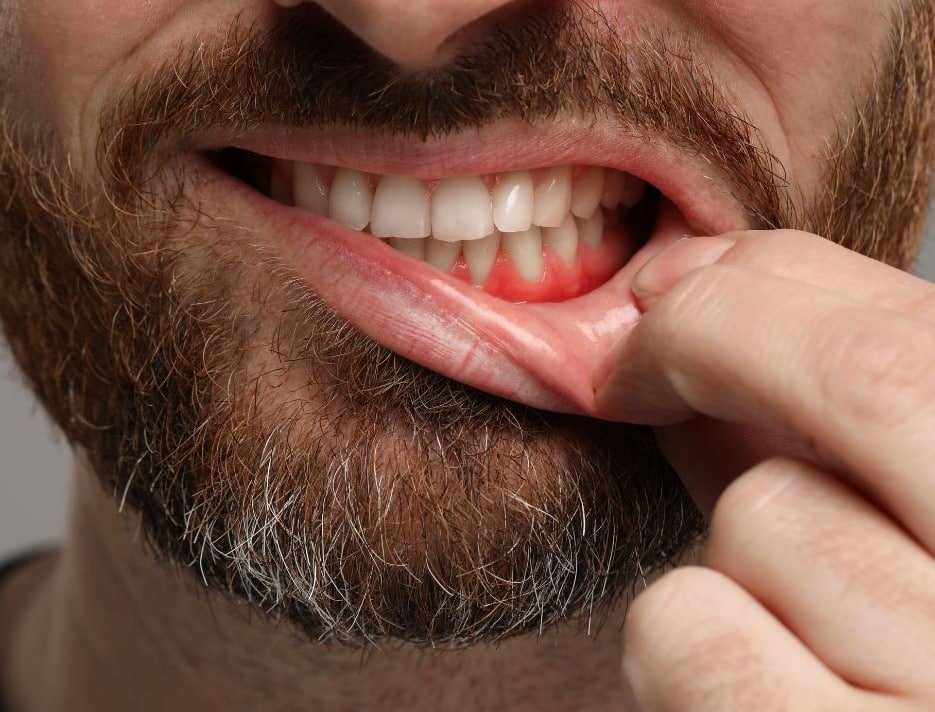
Signs and symptoms to watch for
Some of these seem minor on their own. Together, they paint a clear picture:
Gums that bleed when you brush or floss.
Gums that are red, swollen, or tender.
Bad breath that will not go away no matter how much you brush.
Gums that are pulling away from your teeth, making teeth look longer.
Teeth that feel loose or have shifted position. Pain when chewing. A change in how your bite feels.
If you recognise even one or two of these, it is worth getting a check-up. The earlier we catch gum disease, the simpler and less expensive gum disease treatment tends to be.
What causes it?
Plaque is the primary culprit. It forms on your teeth every day, and if you are not brushing and flossing properly, it accumulates. But several other factors raise your risk. Smoking is the big one. Smokers are significantly more likely to develop periodontal disease, and smoking makes treatment less effective because it slows healing. Diabetes makes your body less able to fight infection, including in your gums. Hormonal changes during pregnancy, puberty, and menopause can make gums more sensitive and more susceptible to gingivitis. Certain medications reduce saliva flow, and saliva is your mouth’s natural defence against bacteria. Genetics play a role too. Some people are simply more prone to gum disease than others, even with good hygiene habits.
Why gum disease is called a silent threat?
There is a reason dentists keep coming back to this phrase. Early-stage gum disease rarely hurts. You might notice a bit of blood on your toothbrush and think nothing of it. You might have slightly red gums and assume that is normal. The disease progresses gradually, and because there is no sharp pain forcing you to act, people put off seeing a dentist. By the time pain or noticeable looseness shows up, you are often dealing with moderate to advanced periodontitis, and the treatment required is more involved.
The link between gum disease and your overall health
This is the part that tends to get people’s attention. The bacteria and inflammation from periodontitis do not stay in your mouth. Research published by the Australian Dental Association and international medical journals has established connections between advanced gum disease and several serious health conditions.
Heart disease is the most studied link. Bacteria from infected gums can enter the bloodstream and contribute to inflammation in the arteries, which increases the risk of atherosclerosis, heart attack, and stroke. Diabetes and gum disease have a two-way relationship: uncontrolled blood sugar makes gum infections worse, and severe gum infection makes it harder to control blood sugar. People with periodontitis who also have diabetes tend to have more complications. Respiratory problems are another concern. Breathing in bacteria from infected gums over time can contribute to pneumonia and worsen conditions like COPD. For pregnant women, active gum disease has been associated with a higher risk of preterm birth and low birth weight.
None of this means gum disease will definitely cause these problems. It means the risk increases, and treating gum disease is one of the things you can do to reduce that risk.
How dentists diagnose gum disease
During a regular dental check-up at 32 Smile Design, we examine your gums visually, checking for redness, swelling, and recession. We use a small probe to measure the depth of the pockets between your teeth and gums. Healthy pockets are 1-3 millimetres deep. Anything deeper than that is a warning sign. We also take dental X-rays to check for bone loss around your teeth, which is often not visible to the naked eye. Based on these findings, we can tell you exactly where you stand and what gum disease treatment, if any, is needed.
The link between gum disease and your overall health
Treatment depends on how far the disease has progressed.
For gingivitis and early periodontitis, a professional dental cleaning is often enough. We remove plaque and tartar from above and below the gumline, and give you a detailed plan for improving your home care routine. Sometimes a follow-up appointment in 4-6 weeks is all that is needed to get things back on track.
For moderate periodontitis, scaling and root planing is the standard gum disease treatment. This is a deeper clean done under local anaesthetic. The dentist cleans the root surfaces to remove tartar and bacterial deposits, and smooths out rough areas on the roots so the gums can reattach more effectively. This is usually done over two or more visits, treating one section of the mouth at a time.
For advanced cases, surgical options may be needed. Flap surgery involves lifting the gums to remove tartar deposits and then suturing them back in place for a snug fit. Bone grafts can help regenerate bone that has been destroyed. Soft tissue grafts can cover exposed roots where gums have receded. Your dentist will walk you through the options and what to expect.
Gum disease treatment options
Treatment depends on how far the disease has progressed.
For gingivitis and early periodontitis, a professional dental cleaning is often enough. We remove plaque and tartar from above and below the gumline, and give you a detailed plan for improving your home care routine. Sometimes a follow-up appointment in 4-6 weeks is all that is needed to get things back on track.
For moderate periodontitis, scaling and root planing is the standard gum disease treatment. This is a deeper clean done under local anaesthetic. The dentist cleans the root surfaces to remove tartar and bacterial deposits, and smooths out rough areas on the roots so the gums can reattach more effectively. This is usually done over two or more visits, treating one section of the mouth at a time.
For advanced cases, surgical options may be needed. Flap surgery involves lifting the gums to remove tartar deposits and then suturing them back in place for a snug fit. Bone grafts can help regenerate bone that has been destroyed. Soft tissue grafts can cover exposed roots where gums have receded. Your dentist will walk you through the options and what to expect.
How to prevent gum disease
Prevention is straightforward, even if it is not always exciting. Brush twice a day with a fluoride toothpaste, spending at least two minutes each time. Floss every day. Most people skip this and it makes a real difference. See your dentist for a check-up and professional clean every six months, or more often if your dentist recommends it. Eat a balanced diet and limit sugary snacks and drinks. If you smoke, quitting is one of the best things you can do for your gum health. If you have diabetes, keep your blood sugar under control.
When to see a dentist
Do not wait for pain. If your gums bleed regularly, if your breath is persistently bad, if your gums look like they are pulling back from your teeth, or if any of your teeth feel loose, book an appointment. Early gum disease treatment is faster, less invasive, and less costly than treating advanced periodontitis.
At 32 Smile Design in Schofields, we see patients from Marsden Park, The Ponds, Rouse Hill, Tallawong, Riverstone, and across Sydney’s northwest. If you are concerned about your gum health or overdue for a check-up, call us on (02) 8809 4301 or book online.
Worried about your gums?
Gum disease rarely hurts until real damage is done. A 30-minute check-up can catch it early, when treatment is simple and affordable.